From First Spin to First Week: How the Original Works
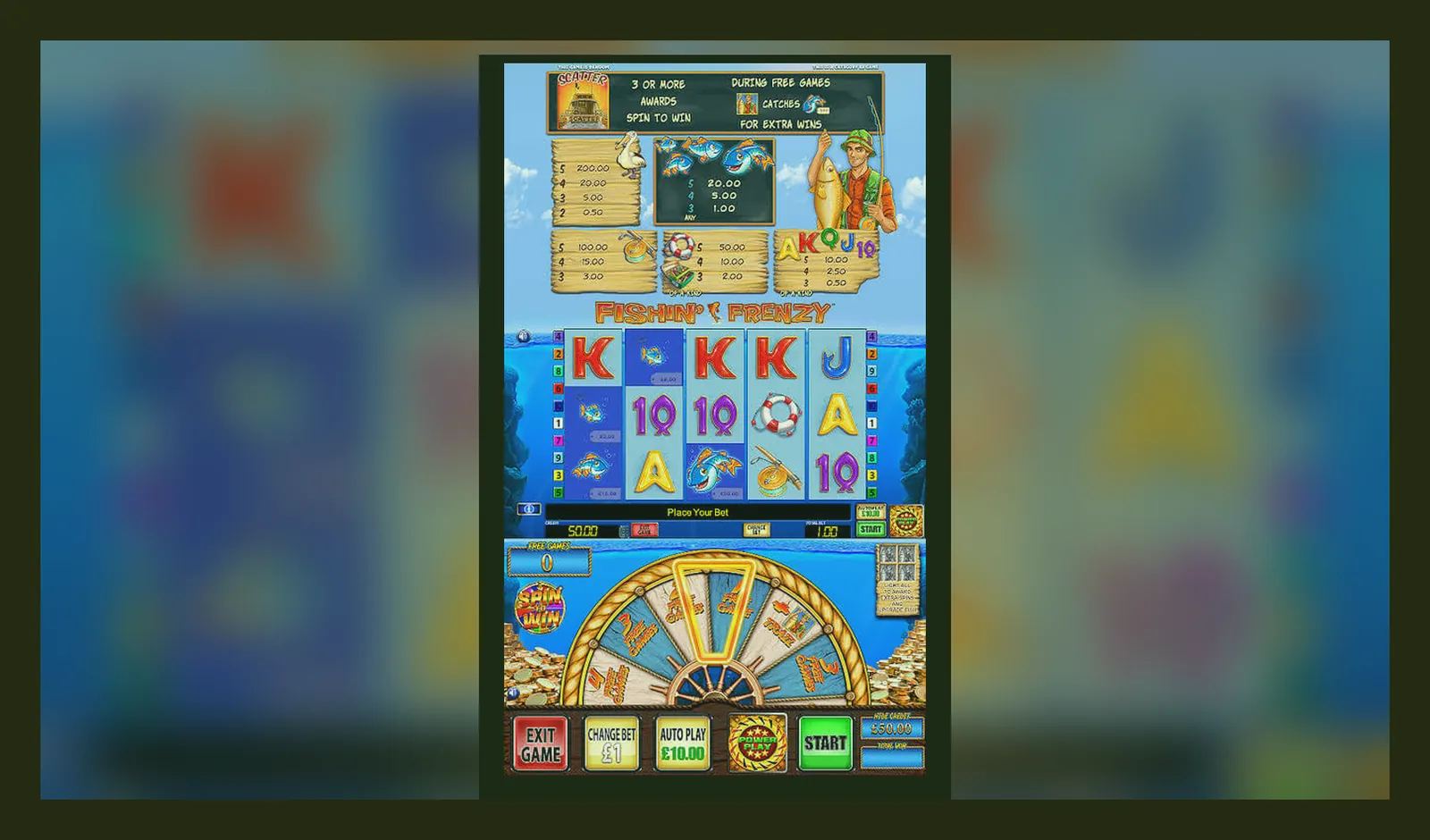
You load the game. Five reels, blue water, cartoon fish hovering in rows. A fisherman in yellow waterproofs stands to the left, rod in hand. The spin button sits bottom-right, the stake selector beside it. You tap the button. The reels spin for two seconds, stop, and either a line of matching symbols lights up or nothing happens. That is the entire loop — no cascades, no hold-and-respin, no narrative. Every outcome is decided the instant you press spin, long before the animations finish.
Blueprint Gaming released the original in 2014. It holds eCOGRA and iTech Labs certificates, and the RNG is audited twice a year. The game runs on UKGC-licensed sites under the studio's own remote gambling software licence. Clones exist — some use the same name, others change a letter — but the maths, the paytable and the maximum win are different. This page walks through the original: how it is certified, how a round actually works, the real numbers from the tech sheet, and a ten-second check that you are playing the licensed version.
The First Ten Minutes: What You See and What the RNG Already Decided
The moment you press spin, the RNG selects a result from 4.3 billion possible reel combinations. The server logs the outcome, calculates the win, updates your balance, then tells your browser which symbols to display. The animation — reels spinning, symbols landing, lines flashing — is cosmetic. The result was final before the first reel stopped.
Blueprint uses a weighted-reel model. Low-value symbols (10, J, Q, K, A) appear more often than high-value fish. The fisherman wild is rarer still, and three or more scatter symbols — the rod and reel — trigger free spins. The paytable shows every combination and its multiplier, but it does not show each symbol's probability. That number sits in the maths model, certified by iTech Labs, and it does not change from spin to spin.
Your stake on a UKGC site is capped at £5.00 per spin if you are 25 or over, and £2.00 if you are 18–24. The game scales the paytable to your chosen stake: a five-of-a-kind pelican at £1.00 pays £50.00; at £0.10 it pays £5.00. The maximum win — 5,000× — remains constant across all stakes, but the absolute cap of £250,000 means that stakes above £50.00 per spin hit the ceiling early. No UKGC operator allows stakes that high on slots, so in practice the 5,000× multiplier is the effective limit.
The First Hour: Base Game, Free Spins, and the Reality of Medium Volatility
Medium volatility means you will see frequent small wins — three 10s, a couple of fish, the occasional four-of-a-kind — interspersed with dead spins. Over an hour at £1.00 per spin, you might trigger free spins twice, lose £20.00 on one bonus and win £45.00 on the other. The maths model balances line hits and bonus frequency so that the game does not drain your balance in ten minutes, but it also does not deliver the massive swings of a high-volatility game like Dead or Alive or Danger High Voltage.
The free-spins round starts when three or more scatters land anywhere on the reels. You receive ten free spins. During free spins, every fish symbol that lands is collected, and on the final spin all collected fish are replaced by the fisherman wild. If you land seven fish symbols across the ten spins, the last spin plays with seven additional wilds on the reels. A full screen of wilds pays 5,000× your stake — the maximum win.
- Three scatters land on reels 1, 3, and 5. Free spins begin.
- Spins 1–9: fish symbols are highlighted and removed from the reels as they land. The game counts them in a counter at the top of the screen.
- Spin 10: the counted fish are added back as wild symbols, distributed across the reels. The final spin plays with extra wilds.
- Wins are calculated with the additional wilds in place. The round ends and you return to the base game.
The mechanic is simple, but the maths behind it is non-linear. Collecting one or two fish adds little value. Collecting five or more turns the final spin into a high-probability event. The average free-spins win is around 30× to 50× your stake, but the distribution is wide: 70% of bonuses pay less than 20×, and 5% pay more than 200×. Medium volatility does not mean predictable — it means the extreme outcomes are less frequent than in a high-variance game, not absent.
The First Week: Pattern Recognition, Variance, and What the RTP Actually Means
After a few hundred spins, you will notice patterns. Free spins might arrive every 80 to 120 spins on average, but the distribution is not even. You might trigger the bonus three times in 50 spins, then go 200 spins without seeing a scatter. The RNG does not track how long it has been since the last bonus — every spin is independent, and the probability of landing three scatters is the same on spin 1 and spin 1,000.
The published RTP of 96.12% is a long-term average calculated over millions of spins. It means that for every £100.00 wagered, the game returns £96.12 on average. But average is not typical. In a single session, your return might be 40%, 110%, or 300%. Over a week, if you play 5,000 spins at £1.00 each, the standard deviation of your result is around £700.00. You could finish £1,500.00 up or £1,200.00 down, and both outcomes sit within two standard deviations of the expected return.
Blueprint does not publish the hit frequency (the percentage of spins that return any win), but third-party tracking suggests it is around 22% to 25%. That means three out of four spins lose. The free-spins feature accounts for roughly 40% of the total RTP, so if you play 1,000 base-game spins without triggering the bonus, your return will be closer to 60% than 96%. The maths model relies on the bonus to recover losses from the base game.
| Session Length | Expected Return | Standard Deviation | Likely Range (±2σ) |
|---|---|---|---|
| 100 spins, £1.00 stake | £96.12 | £95.00 | −£93.88 to +£286.12 |
| 500 spins, £1.00 stake | £480.60 | £212.00 | +£56.60 to +£904.60 |
| 5,000 spins, £1.00 stake | £4,806.00 | £670.00 | +£3,466.00 to +£6,146.00 |
Variance works both ways. A single 1,000× free-spins win at £1.00 recovers 1,000 losing spins. But if that win does not arrive, the base game alone will not keep you break-even. Medium volatility does not eliminate losing streaks — it makes them shorter and less severe than in a high-variance game, but they still happen regularly.
Clones, Reskins, and the Ten-Second Authenticity Check
The original Fishin' Frenzy from Blueprint Gaming is one game. Everything else is either a licensed variant made by Blueprint (The Big Catch, Jackpot King, Megaways, Even Bigger Catch) or an unlicensed clone. Clones copy the theme, the symbols, and the name, but the maths model is different. The RTP is usually lower, the maximum win is smaller, and the certification is absent or fabricated.
- Licensed variants: Blueprint released multiple versions between 2014 and 2024. The Big Catch (2019) added a prize-pick feature. The Jackpot King version (2020) connects to a progressive network and drops the RTP to 96.00%. Even Bigger Catch (2022) increased the maximum win to 50,000×. Megaways (2021) replaced fixed paylines with up to 15,625 ways to win. All variants carry the Blueprint logo and eCOGRA certification.
- Unlicensed clones: games with names like Fishing Frenzy, Fishin Fever, or Fisherman's Fortune that use similar graphics but list a different studio — often one with no web presence or licence history. The paytable might show a 2,000× max win instead of 5,000×, or the free-spins mechanic might award a fixed multiplier rather than collected wilds.
- Reskins: some aggregators rebrand the original under a white-label deal, changing the title screen and UI but keeping the core game intact. These versions are legitimate if the aggregator holds a UKGC software licence, but the branding can be confusing.
The ten-second check: open the game's information screen (usually a button marked with an 'i' or three horizontal lines). The original lists Blueprint Gaming as the developer, shows the eCOGRA or iTech Labs seal, and includes a game ID that matches Blueprint's internal catalogue (the base game is often labelled BP-FFZ-001 or similar). The paytable will show a maximum win of 5,000× stake or £250,000. If any of these details are missing, different, or vague (« certified by independent auditors » without naming the lab), you are not on the original.
Where the Original Runs for UK Players (and What the Licence Actually Guarantees)
The original Fishin' Frenzy is available on every major UKGC-licensed operator: William Hill, Betfair, Sky Bet, Grosvenor, Paddy Power, Ladbrokes, and dozens of smaller brands. Blueprint's content distribution agreement covers roughly 85% of the UK online casino market. The game runs in-browser on desktop and mobile, with no download or app required. Demo mode is available on most sites, but you need a verified account (age check completed, identity confirmed) to access free play — a UKGC requirement since 2020.
Real-money play requires a deposit from a payment method in your own name. Credit cards have been banned for gambling since April 2020, so you'll use a Visa or Mastercard debit card, PayPal, Apple Pay, Trustly, or paysafecard. The first deposit triggers a basic identity check using credit-reference data. If your net deposits reach £150.00 in a month, the operator will initiate an affordability assessment under UKGC rules revised in October 2024. This is not optional — the law requires it, and the operator will ask for proof of income or bank statements if the automated checks flag a risk.
Stake caps apply automatically. If you are 25 or over, the maximum stake is £5.00 per spin. If you are 18–24, the cap drops to £2.00. The operator enforces this in the game client — you cannot override it. The £5.00 cap was introduced in April 2020 alongside the credit-card ban, and the £2.00 cap for younger players followed in August 2021. These limits are set by the UKGC and apply to all slots, not just Fishin' Frenzy.
Winnings are yours, tax-free. The operator pays a 40% Remote Gaming Duty on gross profits (the tax rate increased from 21% in April 2026, and some operators adjusted bonus terms in response). Your withdrawal goes through the same payment method you used to deposit, unless that method doesn't support payouts — in which case you'll use Faster Payments to a UK bank account. E-wallets (PayPal, Skrill) process in a few hours. Bank transfers take one to two working days. The first withdrawal is the slowest because the operator must verify your documents (passport or driving licence, proof of address). 24 to 48 hours is normal. After that, withdrawals are faster.
Terms, Conditions, and the Part Where Demo Becomes Real Money
Demo mode and real-money mode use the same RNG and the same maths model. The difference is that demo wins do not credit your account, and demo losses do not cost you anything. The game does not behave differently in demo — the RTP is identical, the hit frequency is identical, and the variance is identical. But demo results do not predict real-money outcomes. The RNG does not remember your demo session when you switch to real money, and there is no pattern or cycle to exploit.
Every bonus — welcome offer, free spins, reload — comes with a wagering requirement. The requirement is written as a multiplier: 35× means you must wager 35 times the bonus amount before you can withdraw. A £10.00 bonus with a 35× requirement means £350.00 in total bets. Fishin' Frenzy contributes 100% of each bet toward the requirement because it's a slot. Table games contribute less (10% for roulette, 0% for some live dealer games). The requirement is not optional. If you try to withdraw before completing it, the operator will void the bonus and any winnings derived from it.
Bonus terms change. The examples in this text are current as of early 2024, but operators adjust wagering multiples, maximum bet limits during bonus play (commonly £5.00), and eligible games every few months. Always read the terms on the site before you claim an offer. The UKGC requires operators to display key conditions (wagering requirement, time limit, maximum win cap) before you opt in, but the full terms live in a separate document that you need to open and read.
FAQ
How do I know I'm playing the original Blueprint game and not a clone?
Open the game information screen (the 'i' button or menu icon). The original lists Blueprint Gaming as the developer, shows an eCOGRA or iTech Labs certification seal, and states a maximum win of 5,000× stake or £250,000. The paytable should also show the free-spins mechanic where collected fish turn into wilds on the final spin. If any of these details are missing or different, you are on a clone. Cross-check the operator's UKGC licence number in the footer with the public register to confirm the site is legal.
Why do free spins sometimes pay nothing even with several fish collected?
The fish-collection mechanic adds wilds to the final spin, but wilds do not guarantee a win — they only substitute for other symbols to complete paylines. If the final spin lands wilds in positions that do not form a matching combination (for example, wilds on reels 1 and 5 with no connecting symbols), the spin pays zero. The mechanic increases the probability of a win, but it does not eliminate losing outcomes. This is part of the game's variance.
Can I play the original on my phone without downloading an app?
Yes. The game runs in your mobile browser (Safari on iOS, Chrome on Android) with no download required. The interface scales to fit your screen, and the controls (spin button, stake selector, paytable) remain the same as the desktop version. Blueprint does not offer a standalone app for Fishin' Frenzy — it is always accessed through the casino operator's site or web app.
What happens if I hit the £250,000 maximum win at a £1.00 stake?
The game caps the payout at £250,000 regardless of the multiplier displayed on screen. A 5,000× win at £1.00 pays £5,000.00, but a 5,000× win at £100.00 (if that stake were possible) would still cap at £250,000, not £500,000. In practice, UKGC stake limits mean you cannot wager more than £5.00 per spin, so the maximum real-money win you can achieve is £25,000 (5,000× £5.00). The £250,000 cap exists to cover scenarios where the game runs in jurisdictions with higher stake limits, but it does not apply in the UK.